Battery Recycling
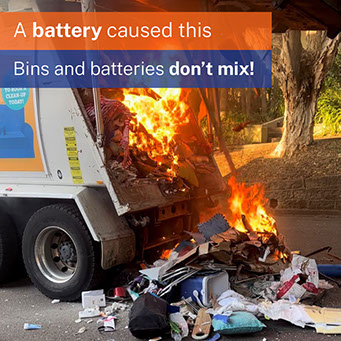
However, with this growing reliance on batteries comes an alarming increase in battery-related fires.
All batteries, particularly lithium-ion batteries, should never be disposed of in your kerbside red, yellow or green bins. They contain chemical substances that can be harmful to human health and the environment and are highly combustible.
Batteries not only have the potential to spark fires but also contain valuable heavy metals like lead, mercury and lithium, so binning them is a waste of these resources and a nasty environmental pollutant when incorrectly disposed.
There are a number of options available to residents of the Northern Rivers to safely dispose of batteries, depending on whether they are removable or embedded.
Removable Batteries
Many products have removable batteries. When these are used, tape both ends of the battery terminals with clear sticky tape, store them in a safe location out of reach of children and then drop them off at your nearest battery recycling collection point.
How to tape battery terminals:
Safe disposal and recycling of removable batteries
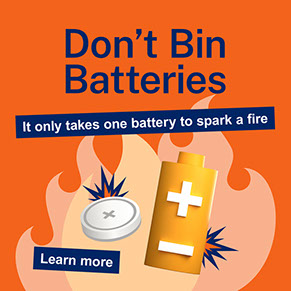
Loose handheld (AA, AAA, C, D, 9V, 6V and button cell batteries) can be recycled at the following locations:
- Your local Community Recycling Centre - Link
- Household Chemical CleanOut events - Link
- Woolworths, Coles, Aldi, IGA and Bunnings
- At any B-cycle accredited location (up to 5kgs) - Link
Car batteries can be recycled at any Community Recycling Centre or Household Chemical CleanOut event.
Find out more about Safe Battery Recycling through the NSW EPA
Embedded Batteries
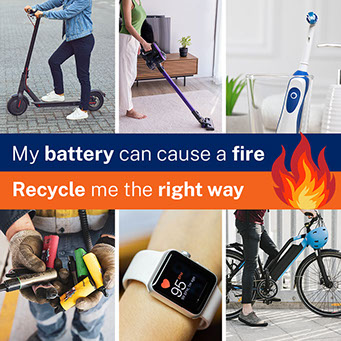
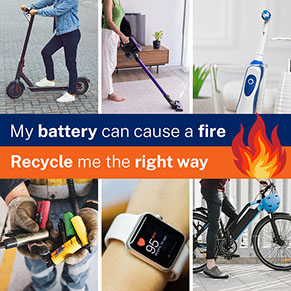
An embedded battery is permanently built into a device and cannot be easily and/or safely removed, meaning they cannot be recycled separately. They are often found in rechargeable items like smart watches, vacuums and Bluetooth speakers.
Products with embedded batteries are considered problematic as they can be difficult to dispose of or recycle at their end of life due to the different components and materials that they’re made of.
Embedded Battery Recycling at
Lismore, Ballina & Kyogle Community Recycling Centres
New FREE Trial
The NSW EPA has established a trial in partnership with Lismore City Council, Ballina Shire Council and Kyogle Council, to accept products with embedded (built-in) batteries.
Residents of the Ballina, Byron, Clarence Valley, Kyogle, Lismore, Richmond Valley and Tweed local government areas are able to drop off items containing embedded batteries at either of these three Community Recycling Centres:
Lismore
Address
Lismore Recycling & Recovery Centre
313 Wyrallah Road, East Lismore
Hours
Mon to Fri 7.30am - 3.30pm
Sat & Sun 9am - 4pm
Contact
Phone 1300 873 387
MORE INFO
Ballina
Address
167 Southern Cross Drive, Ballina
Hours
Mon–Sun: 8am–4pm
Contact
Phone (02) 6686 1287
MORE INFO
Kyogle
Address
Kyogle Landfill Facility
Address: Runnymede Road, Kyogle
Hours
Mon–Fri: 7.30am–12pm
Sat–Sun: 9am–4pm
Contact
Phone (02) 6632 3002
MORE INFO
What products are accepted as part of the Embedded Batteries Trial?
Products covered under the National Television and Computer Recycling Scheme (NTCRS) should be directed to your Council’s e-waste collection, at your local Community Recycling Centre. This includes e-waste such as televisions, computers, printers, computer parts and peripherals. E-waste products containing an embedded battery, such as rechargeable gaming controllers and laptops, are also accepted as part of the NTCRS rather than through the trial.
For more information on the NTCRS, please visit: dcceew.gov.au
Common items you might have at home that may contain an embedded battery are:
- Bluetooth speakers and headphones
- Electric toothbrushes
- E-scooters, e-bikes and hover boards
- Flashing/light up toys – particularly wands or other hard plastic products
- Personal care devices (eg. shavers)
- Powerpacks and portable charging devices
- Remote controlled and ride-on toys
- Vacuum cleaners (cordless hand-held and robotic)
- Vapes
- Wearable devices such as smart watches, trackers and medical aids
If you have an unusual product, please phone the relevant CRC (contact details above) ahead of arrival, to see if it can be accepted.
There are now 34 Community Recycling Centres participating in the embedded batteries trial, including the Lismore, Ballina and Kyogle CRC. For more information including the location of all participating Community Recycling Centres, visit the NSW EPA website.
What products are not accepted as part of the Embedded Batteries Trial?
Mobile phones and associated accessories should be directed to your nearest MobileMuster collection point. MobileMuster is the product stewardship scheme for the collection and recycling of old and broken phones, chargers and accessories. These can be recycled at any MobileMuster location.
Oversize items are not accepted. Check with your Council before presenting anything over 20kgs or that is bulky/requiring special delivery and/or more than one person from a manual handling perspective.
Only household quantities of the above materials will be accepted.
Maximum 20 litres or 20 kilos of each material accepted per visit.
For more information on your local CRC, contact your local council or visit www.epa.nsw.gov.au/recyclingcentres
Visit your local Council's website for more info on waste and recycling
Brought to you by the NSW Environment Protection Authority.